
French & Spanish Learning Resources for Kids
French Worksheets & Printables
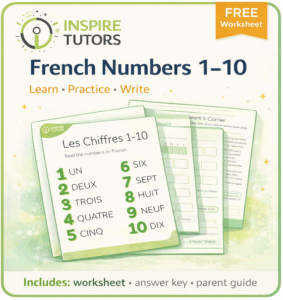
Learn French Numbers 1–10 Worksheet
Help kids learn French numbers from 1 to 10 with a simple printable worksheet set.
Includes a number reference page, writing activity, answer key, and parent guide.
Great for beginners, homeschool learners, or early French classes.
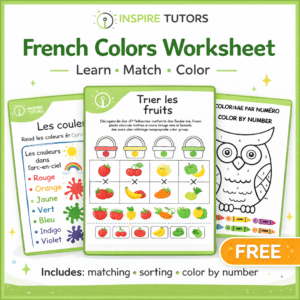
French Colors Worksheet for Kids
Help kids learn common French colors like rouge, bleu, jaune, and vert.
Includes matching activities, sorting exercises, and a color-by-number page to reinforce vocabulary.
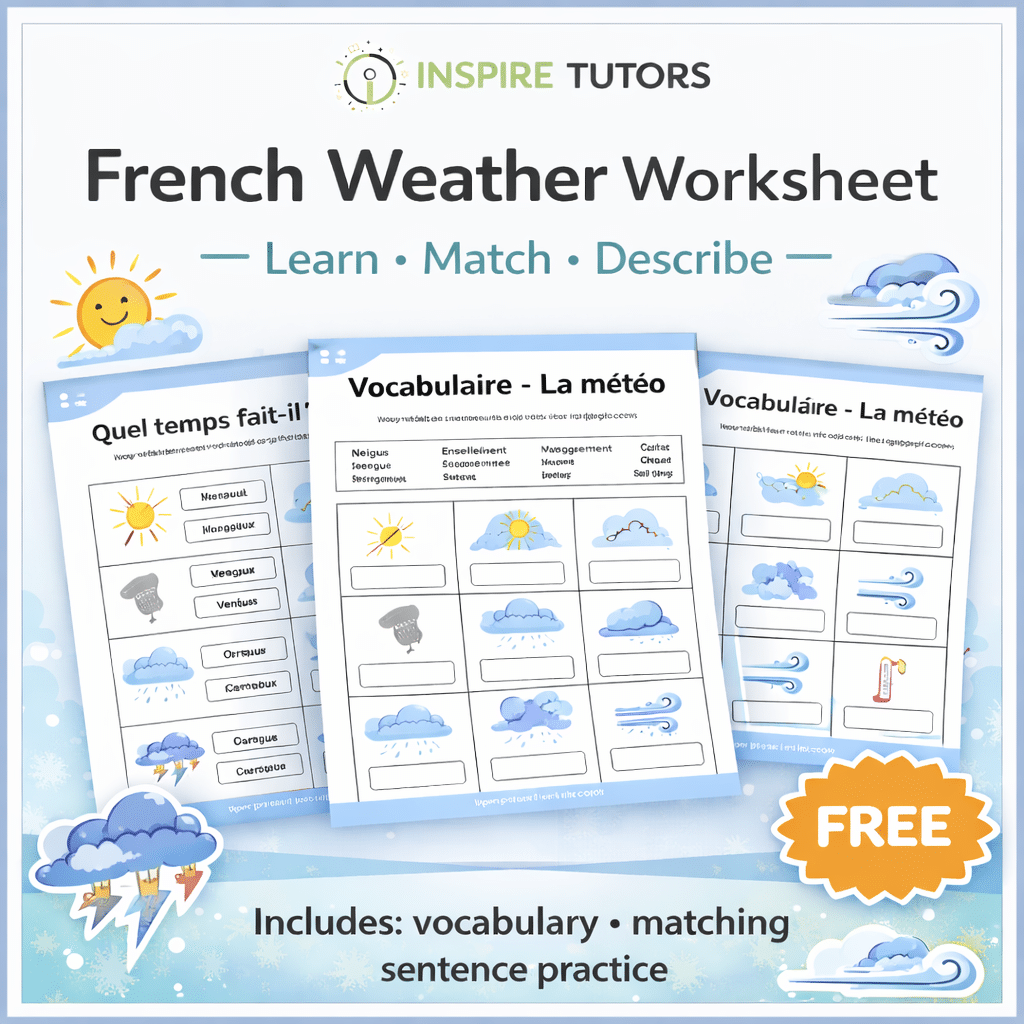
French Weather Worksheet
Teach kids how to talk about the weather in French.
Students match weather words to pictures and practice simple phrases like il neige and il fait chaud.

French Animals Worksheet for Kids
Introduce common animal vocabulary in French through simple matching and labeling activities.
Kids connect animal pictures with words like chat, chien, lapin, and oiseau.
All Courses
Choose a track below to see the full roadmap. Each program is designed around realistic progress: consistent guided practice in class, balanced across Listening, Speaking, Reading, and Writing.
French as a Second Language Levels
Best for beginners or students who want a structured, confidence-first foundation.
| Level | CEFR | Guided Hours (Teacher Time) | Est. Duration (at 2h/week) | Key Achievement Milestone |
|---|---|---|---|---|
| Level 1: The Architect | A1.1 | 40–60 hours | 20–30 weeks | The Internal Library: Introduces self, masters numbers/colors, and follows 100% in-language commands. |
| Level 2: The World-Builder | A1.2 | 50–70 hours | 25–35 weeks | The Social Foundation: Describes home, family, and needs; participates in simple “this or that” debates. |
| Level 3: The Visionary | A2.1 | 70–90 hours | 35–45 weeks | The Future Projection: Uses future tenses to talk about dreams, travel plans, and intentions with ease. |
| Level 4: The Voyager | A2.2 | 80–100 hours | 40–50 weeks | The Storyteller: Narrates past weekends/vacations and handles real-world social scenarios (shops/doctors). |
| Level 5: The Explorer | B1.1 | 100–150 hours | 1+ year | The Strategist: Solves problems in-language and explains the “why” behind personal opinions. |
| Level 6: The Ambassador | B1.2 | 100–150 hours | 1+ year | The Advocate: Summarizes complex texts and debates social issues like technology and history. |
Tip: On mobile, scroll sideways to view all columns.
A Note from Our Educators: Building a Lifelong Language Foundation Click to expand Click to collapse ▾
At our academy, we view learning French as more than just a school subject—it is the opening of a new world. Our French as a Second Language track is designed for students starting their journey from the ground up. To ensure your child doesn't just "memorize" but actually acquires the language, we follow a curriculum rooted in the CEFR international standards.
The Science of "Guided Hours"
The primary question we hear is: "How long does it take to become fluent?" According to global linguistic standards, reaching a new proficiency level requires between 60 to 100 "Guided Hours" of active teacher interaction.
Because students have busy schedules with limited time for homework, we build the necessary repetition and practice directly into our two weekly sessions. This “Realistic Progress” model ensures:
- Solid Retention: We move at a pace that allows the brain to turn new sounds into “muscle memory.”
- The 4-Pillar Mastery: Every hour supports Listening, Speaking, Reading, and Writing. We don’t skip grammar and literacy; we make them accessible.
Our "Internal Library" Approach
For a beginner, the biggest hurdle is confidence. We start by building the “Internal Library”—a core set of phonics, identity verbs, and essential classroom commands.
- Early Success: In Level 1 (The Architect), we prioritize 100% in-language immersion for basic tasks, giving your child the immediate win of “thinking” in French.
- Sustainable Growth: By Level 3 (The Visionary) and beyond, we transition from simple greetings to complex storytelling and debating global issues.
Our Commitment to Your Child
Every 12 weeks, you will receive a Pillar Progress Report detailing specific achievements. Our goal is Spontaneous Fluency—where your child can express their personality, humor, and opinions in French as naturally as they do in English.
French Immersion Levels
For students already in French Immersion who want stronger accuracy, grammar, and literacy.
| Level Name | CEFR | Duration (2h/week) | Core Topics (1 hour per session) | Achievement Milestone |
|---|---|---|---|---|
| Year 1: The Precision Architect | A1/A2 | 45–50 weeks | Grammar "Reset": Noun genders, silent letters, and present tense -er/-ir/-re patterns. | Accuracy: Eliminates common spoken/written "bad habits" and masters basic noun-adjective agreement. |
| Year 2: The Narrative Visionary | A2 | 45–50 weeks | Storytelling: Mastering the Futur Simple endings and irregular future stems (aur-, ir-, ser-). | Flow: Can narrate complex past and future dreams fluently without switching to English. |
| Year 3: The Independent Voyager | B1.1 | 45–50 weeks | Logic & Strategy: Expressing necessity/ability (devoir/pouvoir) and solving problems in-language. | Independence: Can explain the "why" behind personal opinions and handle unexpected social situations. |
| Year 4: The Critical Thinker | B1.2 | 45–50 weeks | Academic Literacy: Summarizing news/history articles and identifying tone or nuance in texts. | Literacy: Can summarize complex texts and express logical, unscripted opinions on global topics. |
| Year 5: The Cultural Ambassador | B2.1 | 45–50 weeks | Persuasion & Debate: Advanced connectors; debating social issues (Tech, AI, History). | Advocacy: Leads intellectual debates and begins mastering the formal French essay structure (la dissertation). |
| Year 6: The Professional Expert | B2.2 | 45–50 weeks | Academic Mastery: Literary analysis, oral exam prep, and full DELF B2/TEF readiness. | Professionalism: Full academic bilingualism; ready for university-level study or professional work in French. |
A Note from Our Educators: Why the Journey Matters Click to expand Click to collapse ▾
At our academy, we don’t believe in "shortcuts" to fluency. True bilingualism isn't just about memorizing words; it is about building a new way of thinking. Based on our years of teaching experience and the international CEFR standards, we have designed a roadmap that prioritizes quality over speed.
Our "Quality Over Speed" Philosophy
To reach professional fluency, a student must master the 4 pillars: Listening, Speaking, Reading, and Writing. We build the practice time directly into our two weekly sessions for deep retention.
The Immersion Advantage
School provides the environment, but it often lacks time for individualized grammar correction and high-level literacy training. We fix “playground grammar” and bridge the literacy gap—moving students into analysis and debate.
Spanish as a Second Language Levels
Best for beginners who want strong pronunciation, confidence, and real “muscle memory.”
| Level Name | CEFR | Duration (2h/week) | Core Topics (1 hour per session) | Achievement Milestone |
|---|---|---|---|---|
| Year 1: The Architect | A1.1 | 45–50 weeks | Phonics, greetings, numbers, identity verbs (ser/estar), and classroom commands. | Foundation: Follows 100% in-language instructions and introduces self with confidence. |
| Year 2: The World-Builder | A1.2 | 45–50 weeks | Family, house, animals, clothing, and regular present tense verbs (-ar, -er, -ir). | Social basis: Describes their world and expresses likes/dislikes. |
| Year 3: The Visionary | A2.1 | 45–50 weeks | Near future (ir + a), simple future, travel, dreams, and intentions. | Projection: Shares dreams and upcoming plans with ease. |
| Year 4: The Voyager | A2.2 | 45–50 weeks | Past tenses (pretérito vs imperfecto), weekends, community, and health/doctors. | Storyteller: Narrates past experiences and handles real-world travel scenarios. |
| Year 5: The Explorer | B1.1 | 45–50 weeks | Logic & problem solving: necessity (tener que/deber) + explaining opinions. | Strategic use: Solves problems in-language and navigates unexpected situations. |
| Year 6: The Ambassador | B1.2 | 45–50 weeks | Influence & debate: summarize news, cultural history, and social issues. | Advocacy: Summarizes complex texts and leads debates on familiar topics. |
A Note from Our Educators (SSL): How we structure 2 hours/week Click to expand Click to collapse ▾
Since these students do not have the “ear” of immersion learners, our two weekly sessions build confidence through the 4 pillars: Listening, Speaking, Reading, and Writing.
- Phonics first: Consistent vowels + tricky letters (ñ, j, h, rr) so students can pronounce what they read.
- Ser vs estar: Reinforced until it becomes automatic.
- Verb rhythm: Endings trained as muscle memory through repetition + games.
Parent progress checkpoints
- End of Year 1: Introduce self, count to 100, and respond to instructions with no English used in class.
- End of Year 4: Can talk about their day, a past vacation, and future plans using three tenses accurately.
Spanish Immersion Levels
For students already in Spanish Immersion or bilingual programs who want accuracy, literacy, and higher-level writing.
| Level Name | CEFR | Duration (2h/week) | Core Topics (1 hour per session) | Achievement Milestone |
|---|---|---|---|---|
| Year 1: The Precision Architect | A1/A2 | 45–50 weeks | Literacy reset: accents (tildes), silent “h,” gender agreement (el/la/los/las). | Accuracy: Eliminates common spelling and gender errors in writing and speaking. |
| Year 2: The Narrative Visionary | A2 | 45–50 weeks | Storytelling: pretérito vs imperfecto + irregular future stems (tendr-, har-, saldr-). | Flow: Narrates detailed past and future stories without hesitation. |
| Year 3: The Independent Voyager | B1.1 | 45–50 weeks | Subjective thought: intro to subjunctive (wishes/doubts) + problem solving. | Independence: Expresses hypotheticals and handles complex social situations. |
| Year 4: The Critical Thinker | B1.2 | 45–50 weeks | Academic literacy: summarize legends/history; analyze tone in news. | Literacy: Summarizes complex texts and explains an author’s “why.” |
| Year 5: The Cultural Ambassador | B2.1 | 45–50 weeks | Persuasion & debate: formal debate, geography, advanced connectors. | Advocacy: Leads debates and writes structured persuasive essays. |
| Year 6: The Professional Expert | B2.2 | 45–50 weeks | Academic mastery: literary analysis + DELE/AP readiness. | Professionalism: Academic bilingualism; ready for university or professional work. |
A Note from Our Educators: Mastering the Spanish Language Click to expand Click to collapse ▾
Learning Spanish is an investment in a global future. Our goal is to move students beyond “basic conversation” into academic excellence, with balanced growth across Listening, Speaking, Reading, and Writing.
In immersion settings, the challenge is often accuracy: accents (tildes), gender agreement, and selecting the correct past tense. We bridge “Playground Spanish” and “Academic Spanish” with targeted grammar + literacy work.